Sunday, January 19, 2014
Adventure-mobile
Most of us, most of the time, go looking for waves on four wheels. Whilst I'd certainly love to arrive at a remote surf spot by boat, bike or boots more often, the reality is that more often than not I find myself throwing my surfboards in or on a car and driving. I almost always wish that I was going in a Land Rover. Big but not really big enough to easily transport surfboards inside, expensive and thirsty for fuel, they're probably not the most practical option but the day-dreamer in me loves the idea of driving along miles of deserted beach scanning the waves for a perfect set-up, fording rivers and settling down to sleep in a roof tent at the end of the day.
Developed in 1947 by the Rover car company in an attempt to skirt post-war materials rationing and make up for the drop in sales of it's luxury cars, the Land Rover was designed to be a light agricultural and utility vehicle, something of a cross between a light truck and a tractor. Intended only for a short production run of two or three years until the luxury car market had recovered, Land Rover developed into its own successful brand and in 1992 Land Rover claimed that 70% of vehicles produced were still in use. The original Series I was designed to minimise the need for materials that were still rationed following WWII (such as steel), and to use simple production techniques and tooling; the bodywork was handmade from an aluminium/magnesium alloy (called Birmabright) which is still used today due to it's light weight and resistance to corrosion, and flat panels and constant radius curves were used to make it simpler to cut and form by hand around simple jigs. The chassis was welded from box-section steel for ease, and the first vehicles off the production line were all offered in a single colour option of military green because the only paint that the company could get hold of was army surplus.
Perhaps it's because of their iconic design and the fact that each successive model has remained true to their original utilitarian function that Land Rovers are still so desirable. It's certainly not for their top speed or road tax band. But having seen one of these boxes on four-wheels as the workhorse carrying so many epic overland expeditions (on the search for surf or not) across deserts, over mountains and through jungles, it would be difficult to put any other vehicle at the top of your dream kit-list when planning a trip that you want to title an expedition.
Sunday, January 12, 2014
Farewell, Dear Friend
Earlier this week the one hundredth and final issue of The Surfer's Path magazine was pushed through my letterbox.
The arrival of the centenary issue should have been one of celebration but instead it was, for me at least, a sad occasion as I read the accompanying letter from the magazine's publishers. I first picked up a copy of The Surfer's Path sixteen years ago as a young teenager. It was issue 6 and it had a dark green cover if I remember correctly. It had a lot of words in it and different photos to the sort that I was used to seeing in the other surf magazines and it cost a bit more too, so my young, short-attention-span, bright colours and fast music angled brain probably didn't really get it. As I matured and my understanding of surfing and the culture that surrounds it developed I would pick up a copy of The Surfer's Path more and more often - a look at the bookshelf at my Dad's house where my collection of early editions is archived would probably be a good indicator of how my surf-centric brain developed: the frequency of more tabloid, "here and now", surf publications tails off to be replaced by a magazine that carried much broader, deeper content. This was a magazine that spoke to my absolute and all consuming obsession with riding waves and started in some way to satiate my appetite to know more. It's pages were filled with trips to places that I'd often never heard of - far-flung corners of the map where there might be waves but there was definitely a story, sparking in me a wanderlust for far-away coastlines that has had an enormous impact upon my adult life, and for which I am incredibly thankful. It taught me about the value of the marine environment, where waves come from and about the history of surfing. The Surfer's Path taught me that there was more to this whole watery escapade; much more.
I'll pull-up short of descending into an essay on the knock-on effects on "bigger picture" surf culture of big surf companies cutting their marketing budgets and the rise of free surf content on the internet. Now's not the time or place. What I will say, however, is that the world of surfing is going to be a bit thinner, a bit flimsier and without doubt a bit shallower without The Surfer's Path spreading interesting and thought provoking articles with beautiful images selected for their artistic merits and their story-telling qualities. This good stuff will certainly still be around, but we might have to search a little harder for it and may not be able to pick it up, curl the edges of the pages, stuff it in a bag before a bus trip or put it on a shelf to revisit in many years time.
Thank you to The Surfer's Path for informing, entertaining and inspiring, to it's editor Alex Dick-Read for your service to surf culture and to all of the photographers, writers and subjects who appeared in it's pages for showing me just what's possible if you put your head down and paddle hard.
Sunday, January 5, 2014
Take A Trip
I've never been shy about the fact that, when given half a chance, I'll shoot analogue over digital for my personal photographic work. I kind of feel that the images produced look more like the photographs that I grew up looking at, and when I'm making memories for myself rather than shooting imagery for a client or editor then I'd rather the resulting photographs hold that warm haze of nostalgia. To that end, more often than not I have an Olympus Trip 35 camera crammed into my pocket or rattling around in my bag. I have a selection of other 35mm SLRs that I'll carry as my "prime" analogue camera, but the little olympus is ever-present and as a result when I finally put a roll of film in to be developed I tend to get back a set of prints spanning several months, and usually with a good few keepers in there.

Porto, where Portuguese Port comes from.
For a camera that you can fit into your pocket, the trip is hard to beat. Olympus produced over 10 million of them between 1967 and 1984, so there are loads of them kicking around and you can pick one up for between £5-£25 on that popular interweb auction site or in a charity shop or car boot sale. They have a fully automatic exposure and you can set the aperture value, but the main bonus is that these little beauties are solar powered and so you never need worry about running out of batteries. You get sharp, rich images which is great, but what's even better is getting that feeling of nervous anticipation when you collect a set of prints from the lab; what was on this film? Did I set the focus right? Was that roll of film that I found at the back of the fridge expired or not? As a pocket camera to get that childhood feeling of making photographs and achieving a different look to your photos without having to use a filter app on your phone, I can't recommend taking a trip highly enough.
Isaac, way back before he became a lean, mean, sock eating machine.
Kate looking back at Honister Pass, The Lake District, UK.
The Rialto, Venice.
Only one guy out.
The trips small size makes it nice and discreet for shooting out of the way waves and then leaving your camera under a towel on the beach.
Donkey, Atlas Mountains, Morocco. Cross-processed slide film.
Mackerel and colourful crates.
Port Isaac, a place that I don't photograph enough. Cross-processed slide film.
Summer feet.
The Souk, Marrakech. Cross-processed slide film.
One of Venice's many beautiful basilicas.
Jarrad is a mate of mine from Western Australia. He's been working in London the past few years and goes long stints without watching the sun set into the sea. When he visited earlier this year it reminded me not to take that daily gift for granted.
Probably safest not to touch or eat these. Autumn woodland walks.
Like these images? There are more like this on my tumblr page, or you can follow me on instagram or facebook if you so wish. Ta!
Sunday, December 29, 2013
Set Sail For Adventure
"A ship is safe in harbour, but that's not what ships are for."
William G.T. Shedd
It's that time of year when resolutions are made and plans for the year ahead start bubbling away. Whether your plans are set close to home or further afield, just make sure that you get out there and enjoy yourself. The world is best enjoyed first hand rather than through a screen after all. Wishing you all a very happy, fulfilling, productive and adventurous 2014, I hope to see you out there.
Monday, December 23, 2013
Monochromatic Mountains
In Winter the colours of nature are often desaturated. The light can be flat and dull, as though your whole world has been placed inside a giant tupperware box. To me, mountains are a wintery landscape with a colour palette limited to the white of snow and ice over the black of rock. If the sky is not bright blue but neutral grey instead, then the whole scene appears to our eyes in black and white. There aren't many occasions as a photographer when you get to compose an image on monochromatic film seeing it through the viewfinder more or less as you will see it once the film is developed. Sometimes it's nice to look at the natural world devoid of the distractions of colour and to simply absorb the beauty of tone and texture that become so obvious when we look at things in black, white and shades of grey.
Images from top to bottom:
- Towards Mount Adam
- Avalanche Valley, where I spent a week stranded waiting for the road to be declared safe to pass.
- The Tree Line
- The Southern Alps, South Island, New Zealand
Monday, December 16, 2013
A Wooden Wave
10x European Longboard Champion Ben Skinner racing on a hollow wooden surfboard built for the National Trust using timber from a storm damaged tree felled on one of their Cornish properties.
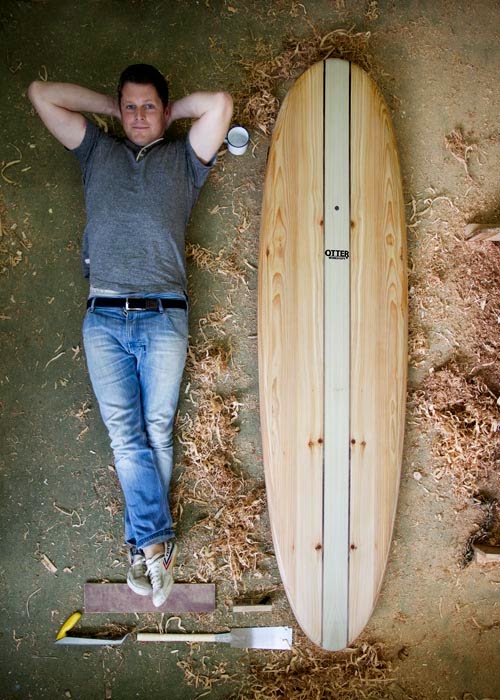
I've amassed quite a collection of images over the past year or two that I've been working with Otter Wooden Surfboards, but because they sit in a different folder on my computer and are technically "work" it has only just occurred to me to share them on here. Technically speaking I'm James' "content manager" (pictures and words guy), shooting all of the brand's imagery and writing the Otter Surfboards blogs, newsletters and press releases. It's a job that has seen me swimming around in the shorebreak with my camera, hoisted up the mast of a wooden pilot cutter in the bosun's chair, bivvying on the beach in the summer and trying to keep my fingers warm enough to click the shutter button before the sun's come up in the depths of winter. It's been great. One of the best parts of my role at Otter is spending a bit of time in the workshop when there are "Build-Your-Own" courses running, meeting the customers who arrive to a stack of raw timber on a Monday morning and documenting their progress throughout the week before they emerge on Friday afternoon as firm friends with a beautiful wooden surfboard that they've built and shaped themselves. Check out the recently released film below, shot by Tiny Dog Films at our first "AGM" (BBQ) this past October, and our appearance on BBC1's Countryfile that aired last night. In the meantime, here below is a selection of my favourite images from a great 2013 spent shooting lovely wooden surfboards, workshops and waves for Otter:
Otter Workshop from Otter Surfboards on Vimeo.
"Man Overboard" shot from the bosun's chair hoisted up the mast of the Pilot Cutter Hesper.
James and his dog Buddy, on the search for surf and a spot to sleep on the beach.
Kingley's "Desert Island" surfboard, a 7'4" Island Hopper that he built during a workshop week earlier this year.
A 9'8" big wave gun nearing completion, built for Surfers Against Sewage for Ben Skinner to surf a wave of significant height on to raise the profile of more sustainable surfboard materials.
In the summer the trestles can be moved outside. James guiding Eddie in shaping the rails of his surfboard.
Our Christmas bodysurfing image: Surfboard offcuts get turned into handplanes, kind of the bodysurfing equivalent of snow shoes.
Tim joined us for a week in August to build and shape his own 9'4".
Dawn sessions in December.
Jimmy test riding a 5'6" mini-simmons inspired planing hull, made entirely of Western Red Cedar.
I also make the tea.
Sunday, December 8, 2013
Pipeline
"The passage of time does not diminish the mind's astonishment at how one place can be both so overwhelmingly beautiful and so completely terrifying, all at the same time."
Gerry Lopez, "Surf Is Where You Find It"
It is the most famous, most revered and most photographed wave in the world.
It is also pound for pound the deadliest. Every year in early December the World Championship Tour comes to a dramatic conclusion over this small but perfectly formed patch of reef in the middle of the North Shore of Oahu's seven mile miracle, and it's about the only time that you'll see just two people at a time sharing the peak at Pipeline. I mean, there are surf contests, and then there is the Pipe Masters contest. This year, as is often the case, the title race has come down to the wire: If the current tour ratings leader (and former 2x world champion) Mick Fanning comes in lower than third place then eleven times former world champion Kelly Slater can snatch the world title away from under his nose with a win in this contest. Kelly hasn't secured a world title in the final contest of the year since the 1990's (before his retirement and subsequent return to competition) so the stage is set for a dramatic conclusion to the year. The Pipe Masters is on right now (Sunday evening GMT) and you can watch the action live here. Even though Joe Turpell somehow still has a job commentating on surf contests it'll definitely worth tuning into over the next couple of days.
Images, top to bottom:
- Splitting the peak; one surfer goes right at Backdoor whilst another takes on the left of Pipeline.
- Winter in Hawaii: Bring a bigger board and make sure that it has a pointy tail.
- 2000 ASP Men's World Champion Sunny Garcia making the most of a blip of swell one windy afternoon in October 2007.
- The price of Pipe. Right before you step onto the sand from the Ehukai Beach parking lot, on the left hand side nearest Pipeline, the wire fence hosts a memorial to surfers who have paid the ultimate price surfing Pipe. Many of them were professional surfers and it stands as a stark reminder of just how dangerous this wave is - just in case you thought you might paddle out and have a crack.
Labels:
ASP,
Backdoor,
Hawaii,
Kelly Slater,
Mick Fanning,
North Shore,
Pipe,
Pipeline,
Surf Photography,
Waves,
WCT
Subscribe to:
Posts (Atom)