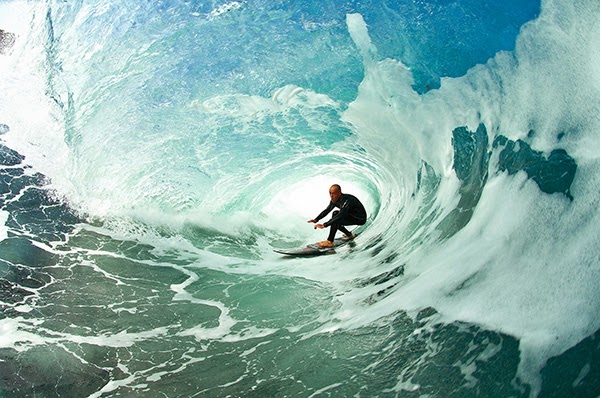
Showing posts with label cold water surf. Show all posts

Sunday, May 10, 2015

The S-Factor


Flashback to the middle of winter:  I am bloody freezing.  
My hands are doing that claw thing where they get so cold that you can’t close your fingers together and that, along with a thick, heavy wetsuit, makes paddling anywhere more mission than movement.  Crossing my arms and hugging my numb paws into my armpits just hurts, so I decide that holding them under the water and keeping them out of the wind is a better idea.  The light is flat and grey and there is a band of rain being carried towards me on the onshore wind; I watch the opaque curtain envelop the headland a mile away and wonder what’s keeping me out here scratching around for waist-high onshore mush?  A small part of me is secretly hoping that the angry bull seal who took up residence here last winter, and who’s developed a reputation for bullying surfers back to the beach, will turn up so that I have an excuse for catching a wave in. 


I’m not living some sort of cold-water surf adventure right now; there are no scenic mountains when I look inland, the beach isn’t covered in snow and there are no killer whales cruising the line-up or bears stalking the shoreline.  Just our territorial seal whose intentions none of us are ever absolutely certain of when he surfaces within kicking distance of one of us.  But it’s plenty cold enough and to be honest once your extremities are numb I’d argue that the difference between the water temperature being 7 degrees and 5 degrees Celcius isn’t noticeable, particularly once you factor in the wind-chill.  Cold is cold, it’s as simple as that.  And this is the reality for an awful lot of surfers.  Life isn’t one long boardshort advert.

So what keeps so many of us in the sea for so long when often it’s uncomfortable and not the most productive use of our time?
What is the “S” factor?
There’s a strong case for the argument that those surfers who you see bobbing around the line-up on a distinctly average day in mid-winter, or obsessively hopping from look-out spot to look-out spot searching for waves just because it’s the weekend, have another thing driving them.  It’s that little something that separates them from the multitude of humans who have caught a wave at some point in their life but not succumbed to the obsession and let it take control of their day-to-day.  It stands to reason; if every person who learnt to stand up on a surfboard had this then the line-up would be just as crammed on a dreary onshore morning in mid-winter as it is on the sunniest day of the summer holidays.  But it’s not.  It’s just the select few who have mastered the ability to turn the key in the car door when their hands are too cold to function properly or who often don’t get the feeling back in their toes until the end of the evening news, long after dark has fallen.

Take yourself as an example:  Have you ever made a decision where the dominant influence in your choice was surfing?  A big decision perhaps, like where you live or what you do to earn a living?  Could you blame surfing for a less than desirable financial situation or the break-up of a relationship?  You see?

The simple answer would be to blame this sort of behaviour on some kind of addictive behaviour trait.  But that’s too obvious to ring true.  If that was the answer then regular surfers would display those sorts of behaviours in other areas of their lives, but the vast majority of us don’t.  Some surfers are happy to forego daily surfs unless the waves are actually good, preferring to survive off memories of better waves and just to scratch the itch when absolutely necessary, on a weekly or fortnightly basis when a new swell shows up on the charts.  Others just have to get in as soon as there’s a lump of water to paddle into; a bad surf is better than no surf sort of attitude, regardless of how frustrating it is.

Call it stoke, call it sensation seeking, or scientifically attribute it to varied levels of neurotransmitters such as dopamine, norepinephrine and serotonin in surfers.  Both dopamine and serotonin help our brains to regulate mood and emotion, are responsible for levels of arousal, and determine how we perceive reward.  It has been put forward that many surfers display behaviours indicative of heightened levels of dopamine, but whatever it’s down to, regular surfers can’t seem to get enough of it in one way or another which is why we keep going back.  The best things are often the most difficult to explain and we all have our own reasons, so don’t worry that when somebody asks why you insist on paddling out whilst everybody else retreats indoors to the comfort of their favourite chair, you struggle to come up with an answer that comes anywhere close to explaining why.  You don’t have to.     


Author's note:  This article first appeared on the Surf Simply Magazine on March 24th, 2015. 

Sunday, January 25, 2015

Chasing Unicorns


The depths of winter, for a surfer in high latitudes, can be like an enormous game of meteorological hide and seek.  Rainbows abound, but the proverbial pot of gold is always retreating over the brow of the next hill.  Swells are often raw and powerful, generated by storm systems that follow closely behind and move over the coast bringing strong winds that swing on a dime.  The clock is there to race as daylight hours are limited and large tides can cause good sand banks and reefs to turn on and off within an hour.  It's all too easy to spend hours on end driving country lanes and slip-sliding down muddy tracks to check obscure little coves only to find out that you've missed the best of it someplace else.  It can feel like you're spending all of your precious free time chasing unicorns - you know that you'll never get one, but it's worth it just to catch a glimpse every now and then.

Sunday, February 23, 2014

Don't Buy It, Build It: My Yellow Submarine


Surfing and making photographs are two pretty defining passions of mine, and every now and then they inevitably cross over. 

But, if I’m honest, I’d always choose to be in the sea rather than stood on the beach watching it.  With the cheapest commercially available waterhousing for a decent camera costing at least a grand (I’m not talking about swimming out with a go-pro here) it would seem that water-based surf photography is a game for an ever-shrinking number of professionals or those with a hefty hobby budget.  I mean, how many jobbing photographers these days have at least a grand burning a hole in their pockets for a piece of kit that they’d be lucky to see generate a few hundred quid in sold images?  

Not me.  So I made one.


Measure twice and make a model.

I ended up making two waterhousings actually.  I have long held on to the philosophy that if you’re able to do something yourself then you should do so – not just as a way of saving money or acquiring something that you couldn’t otherwise afford, but as a means of learning new skills and challenging oneself.  Perhaps it’s just that I have a problem with writing to-do lists and not sitting still, born of an awareness that time is a precious commodity. 
I started out researching waterhousings for surf photography – commonly known as “splash” housings and different to their deep-sea diving counterparts.  I had the choice of fiberglass and resin as construction materials (the honours project for my degree involved the use of advanced composite materials for marine engineering applications, so I was comfortable with that option) or folded and welded aluminium which I'm slightly less au-fait with.  I went with the aluminium challenge.  
A photographer who runs a gallery at the end of my street, Nick Wapshott, kindly lent me his commercially bought waterhousing overnight to take a look at, and I asked a few questions of Tim Nunn (editor of Wavelength Magazine and professional surf-lensman) who gave me some advice on how to trigger the shutter mechanism.  This was the biggest issue – I had no problems making a waterproof box of some description to put my camera in, but finding a way of pressing the button without springing a leak was a challenge.  As with most of my projects, I started out with fairly modest intentions until I realised how much time and effort I was investing and then figured that I might as well do a proper job.
I measured up my cameras (I shoot with the slightly puffed-up digital version of an older analogue camera and they’re such similar sizes that I wanted to make a housing that they would both fit and function in) and made cardboard models.  Friends and acquaintances kindly rummaged in the scrap bins of their workshops and garages, and from a range of sources I ended up with some odd lengths of aluminium tubing that I could machine into lens ports, a bigger piece that might fit a camera, and some offcuts of thin-guage sheet aluminium that I could fold into a box. 
Now, I like to think that I’m fairly handy but I definitely know my limits and one of those is TIG welding aluminium and another one is precision milling.  Luckily for me, just down the raod from me on Bradfords Quay in Wadebridge are two companies who specialise in fettling metal:  Daften Die-Casting specialise in precision aluminium work and Grant and Kevin there took my crude CAD designs and machined the face plates for my housings with the incredibly fiddly grooves for the o-ring seals.  I then delivered a box of bits to Will Irons at MGC Engineering a couple of doors along for the guys there to TIG weld together for me.  Where I would undoubtably have blown holes in the thin aluminum they executed seamless joints that are not only functional, but beautiful in that functional raw metalwork sort of way.

The MGC magicians worked wonders with welding.

I now had two containers that looked a lot like camera housings.  I took them back to Daftens where they were powdercoated bright yellow because if you’re going to make a submarine then it really ought to be a yellow one, right?  I’m sure that there’s a functional reason for marine submersible equipment often being this colour but I don’t need to know about it.

The "Soucoupe" and "Jacqui" nearing completion.

I sourced some thick, clear acrylic and had it cut to fit the face plates and ports then got back at the handles of a lathe and surprised myself at my ability to actually work accurately when I turn my mind to it, turning down the tubing into lens ports to accept my 50mm prime lens.  A fisheye lens would require a domed port, something that there is no way I could produce, so I settled for the fact that I would be shooting from slightly further away from the action and capturing a realistic point of view of what the human eye would normally see.
I stayed late at Otter Surfboards one Friday and mixed up a small batch of epoxy glue to nervously assemble the faceplates and ports, horribly aware that just one tiny smudge of resin on the lens port would bin the entire project.  Finally, to solve my switch concern, I found a company that produces housings for underwater dive cameras and scientific survey equipment (Greenaway Marine) and ordered a simple mechanical switch from them that I could machine to fit my housing and camera.  I assembled everything and then, in early December, took one of the empty containers for a swim in the waves, relieved that it didn’t fill up with seawater and drag me down to the seabed like an anchor.  I then put a roll of film in my analogue camera and took that out, realising just what surf photographers would have had to go through in the days before the digital revolution – swimming back to the beach every thirty-six shots to take the whole business apart and change the film must have been hard work: Thirty-six shots really doesn’t last very long in the sea.

Then the “weather” arrived, and the sea was near enough off-limits for any sane attempts at water photography for weeks on end.  Until this week.  Torn between making up for a lot of lost wave-riding opportunities and testing my handiwork, I tried my best to strike a balance in between actually doing some work.  Having surfed on one day with great waves and beautiful flat, grey, wintery light that looked as cold as it was, I returned to the following spot with my housemate Ben the following day with my digital camera nervously ensconced in it’s (hopefully) waterproof yellow case.  With more than thirty-six exposures to play with, I think that in between swimming against a rip like a river, wearing some monstrously thick wedges on my head and getting bounced off the seabed a lot, I got some alright shots for a trial run.

Here below are some of the results:


Under a pitching lip.

Foam textures.

Scratching over a lump.

Difficult conditions for surfing and shooting.

Benny dodged this barrel and tore into a massive turn just as the whitewater engulfed me.  He's been kicking himself ever since for not tucking himself in there.

The lefts here are normally not much good.  
Not on this day though.

Pitching

Monday, February 17, 2014

Numb: A Glimpse Through The Lens of Tim Nunn


Late one afternoon in December of 2012 I met surf photographer and cold-water explorer Tim Nunn in a lay-by in front of a pub in Cornwall.  It was the run up to Christmas and Tim was spending the weekend driving around the South West delivering signed copies of his new book in person to save people money on postage.  We caught up briefly before he headed off for his next delivery, and I headed home to take a look at the new photography book that would be weighing down my coffee table.

What I found contained between the covers of Numb was incredible - 208 pages of straight-up heavy, cold, slabby, back-of-beyond, remote and beautiful waves.  Over the course of six years Tim and his friend, surfer and hell-man Ian Battrick, explored the frontiers of surfing in the Northern Hemisphere.  They spent inordinate amounts of time in Scotland, drove thousands of miles around Norway's crinkled coastline, slept in tents, tunnels and under lorries in Iceland and fended off bears in the Canadian wilderness.  They had adventures.  They also scored some incredible waves and came away with hundreds of stunning images.


As winter rolled around again and my own thoughts turned to boots and gloves, ice-cream headaches and heavy lips, I sent a few questions across to Tim to find out just what made him and Ian look to the high latitudes for their cold water kicks:


Where does your preference for cold-water surf spots over warm ones come from?  Is it an indifference to temperature or a desire to escape the crowds without having to cut through jungle?
I think it was partially crowds and partially just wanting to go to places that others hadn't been. Warm water exploration had been done, and I had a fascination with the colder regions so it grew from that really. Growing up on the North Sea also meant that the cold really didn't bother me too much.


Have you seen the remote, cold, surf spots that you favour get increasingly crowded as they gain more and more attention in the surf media and become more “fashionable”?
Yes and no. Some of the more accessible areas have for sure, but these became more crowded pre the latest wave of cold water surf popularity. I think it was more down to improved wetsuit technology and the general rise in surfing popularity than the focus on the cold.


Is the camping and wilderness element a necessary result of the high prices in many of the countries that happen to be cold and have waves, or a deliberate choice in the search for adventure?
It's a combination, one is definitely price, in places like Canada it is the only choice, and in general it is the best thing to do as you need to be really mobile, able to respond to the conditions quickly.


What do you get from cold-water trips that temperate or tropical ones don’t deliver?
There is definitely a certain rawness to the environment which only these areas deliver, the weather, the swell, the people all have a certain something that just makes the whole experience more exciting.


What impact does the temperature and resultant drop in flexibility and comfort have on the performance of the surfers who you photograph?
When I started it had a big influence on performance, but now not so much and it is all down to wetsuit tech. The most recent trip to Iceland Ian and myself were both in 4mm suits which are light and flexible, in temps that three years ago would have demanded a 6 mm. Ian had designed them himself, so he knows what he needs and it makes a huge difference to performance.


What do you find the hardest on these trips, the logistics, sleeping out, motivation or getting warm after surfing?
Logistics are probably the toughest, we are always under very tight financial constraints, so getting the most out of a place on a tiny budget is by far the most challenging aspect, the rest is just fun! 


Numb is available to buy here and is thoroughly worth it.  Go on, get yourself some inspiration.


All images copyright Tim Nunn.  My thanks to him for letting me post them here.