Monday, February 17, 2014

Numb: A Glimpse Through The Lens of Tim Nunn


Late one afternoon in December of 2012 I met surf photographer and cold-water explorer Tim Nunn in a lay-by in front of a pub in Cornwall.  It was the run up to Christmas and Tim was spending the weekend driving around the South West delivering signed copies of his new book in person to save people money on postage.  We caught up briefly before he headed off for his next delivery, and I headed home to take a look at the new photography book that would be weighing down my coffee table.

What I found contained between the covers of Numb was incredible - 208 pages of straight-up heavy, cold, slabby, back-of-beyond, remote and beautiful waves.  Over the course of six years Tim and his friend, surfer and hell-man Ian Battrick, explored the frontiers of surfing in the Northern Hemisphere.  They spent inordinate amounts of time in Scotland, drove thousands of miles around Norway's crinkled coastline, slept in tents, tunnels and under lorries in Iceland and fended off bears in the Canadian wilderness.  They had adventures.  They also scored some incredible waves and came away with hundreds of stunning images.


As winter rolled around again and my own thoughts turned to boots and gloves, ice-cream headaches and heavy lips, I sent a few questions across to Tim to find out just what made him and Ian look to the high latitudes for their cold water kicks:


Where does your preference for cold-water surf spots over warm ones come from?  Is it an indifference to temperature or a desire to escape the crowds without having to cut through jungle?
I think it was partially crowds and partially just wanting to go to places that others hadn't been. Warm water exploration had been done, and I had a fascination with the colder regions so it grew from that really. Growing up on the North Sea also meant that the cold really didn't bother me too much.
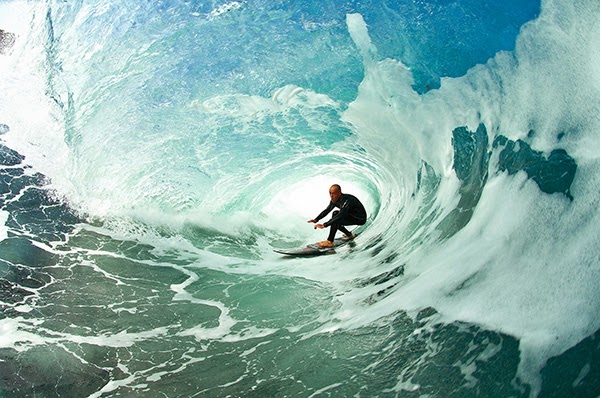


Have you seen the remote, cold, surf spots that you favour get increasingly crowded as they gain more and more attention in the surf media and become more “fashionable”?
Yes and no. Some of the more accessible areas have for sure, but these became more crowded pre the latest wave of cold water surf popularity. I think it was more down to improved wetsuit technology and the general rise in surfing popularity than the focus on the cold.


Is the camping and wilderness element a necessary result of the high prices in many of the countries that happen to be cold and have waves, or a deliberate choice in the search for adventure?
It's a combination, one is definitely price, in places like Canada it is the only choice, and in general it is the best thing to do as you need to be really mobile, able to respond to the conditions quickly.


What do you get from cold-water trips that temperate or tropical ones don’t deliver?
There is definitely a certain rawness to the environment which only these areas deliver, the weather, the swell, the people all have a certain something that just makes the whole experience more exciting.


What impact does the temperature and resultant drop in flexibility and comfort have on the performance of the surfers who you photograph?
When I started it had a big influence on performance, but now not so much and it is all down to wetsuit tech. The most recent trip to Iceland Ian and myself were both in 4mm suits which are light and flexible, in temps that three years ago would have demanded a 6 mm. Ian had designed them himself, so he knows what he needs and it makes a huge difference to performance.


What do you find the hardest on these trips, the logistics, sleeping out, motivation or getting warm after surfing?
Logistics are probably the toughest, we are always under very tight financial constraints, so getting the most out of a place on a tiny budget is by far the most challenging aspect, the rest is just fun! 


Numb is available to buy here and is thoroughly worth it.  Go on, get yourself some inspiration.


All images copyright Tim Nunn.  My thanks to him for letting me post them here.  

Sunday, February 9, 2014

"And Now The Shipping Forecast…"

"Lundy, Fastnet.  Southwest veering West or Northwest for a time 6 to gale 8, occasionally severe gale 9 in west Fastnet.  Squally showers.  Good."


Every once in a while I end up having BBC Radio 4 on when the Shipping Forecast comes on.  It's not very often, but when I hear the clearly enunciated phrase "And now the Shipping Forecast…" it seems to have an instant calming effect on me - most likely because I'm not manning the helm of a fishing trawler in a severe gale 8 many miles offshore.  These 350 words (give or take) that are broadcast four times daily at 0048, 0535, 1201 and 1754 on Radio 4 are largely irrelevant to probably around 99% of the station's listeners, and the other 1% who might put to sea for a living probably check the maritime weather forecast on the internet.  Some might argue that it's irrelevant in the modern age.  But it's an institution, lodged firmly in the national psyche;  a subtle reminder that we are an island nation that has historically relied upon the seas.      


Our ability to predict the weather at sea was the raison d'être behind the formation of the Met Office and the development of modern, scientific, weather forecasting.  In the mid 1800s the large number of ships being lost at sea caused the British Government to appoint Captain Robert Fitzroy (he of Charles Darwin/Beagle fame, as well as for being a former governor of New Zealand and having a building at the University of Plymouth where I sat through a lot of oceanography lectures named after him) to form the Meteorological Office in an effort to provide more accurate information and warnings to mariners.  
The forecast is divided up and follows a strict format: first the date, then gale warnings, the general synopsis and finally the forecast for each of the 31 areas.  Each of these areas is named for a defining feature such as an island, river or sand bank, with Finisterre being renamed Fitzroy in 2002.  The forecast for each of these areas are always read in exactly the same order circulating the British Isles in a broadly clockwise direction.  
Whether or not the Shipping Forecast is a relevant daily broadcast, when the daily news is filled with stories of the British coastline being battered by ferocious storms, enormous waves and howling winds, the Shipping Forecast - read in the calm, measured and hypnotic classic BBC style - serves as a timely reminder of our historical connection with the waters surrounding us.

Sunday, February 2, 2014

Rapid Trajectories


It’s nice to see grommets these days who are hungry to surf better; kids like Liam Murray-Strout here.   

These kids see coaching as a way to improve rather than as some sort of stigma as so many surfers do (I plan on touching on this sometime in the future but, really, why do surfers have such an issue with accepting advice on how to improve whereas it’s the norm in almost any other activity?), and they train hard to improve both their technique and fitness.  They’re also hungry for it; days were when it seemed that the only British surfers with the support of a sponsor came straight out of Newquay and nowhere else, but now the field’s wide open and there is way less sponsorship money going about.  I’m not talking about free stickers here, but kit like wetsuits, surfboards and travel allowances that will help them to perform at their best, year round.  Less help and more competition for it means that grommets these days can’t rest on their laurels and a cool haircut, they have to act and train like young athletes.  But why you may ask?   Can’t they just be happy to go surfing and enjoy it for what it is?  Well yeah, of course.  I’m chronically un-competitive but if I was able to chuck an air, get the tail of my surfboard higher than my head, and ride out of it then I’d be smiling for days. 

There’s nothing wrong with wanting to surf well and working hard for that, because barrels are way better when you get spat out of them - even if nobody’s around to see it happen.


Sunday, January 26, 2014

Big as a Bus


Weighing in at around 36 tons and as big as a bus, Humpback whales are a wonder of nature.  They typically travel around 25,000km each year, spending the summers feeding on krill and small fish in polar waters before migrating to tropical or sub-tropical waters in the winter to breed and give birth, which is where most of their positive interactions with humans occur.  Prior to the International Whaling Commission ban on commercial whaling in 1966, however, their interactions with humans weren't so great as their population had been decimated by 90%, but since then numbers have recovered to an estimated 80,000.  Over the next couple of months there are a couple of events celebrating these gentle giants, World Whale Day on Maui, Hawaii on February 15th and Whale Fest in (lovely but not as tropical) Brighton, UK, over the weekend of March 14-16.  Later this year there will also be a meeting of the IWC, and I for one sincerely hope that the conservation of whales and other cetaceans continues to be an important issue amongst the myriad of problems facing the world's oceans.